Cancer Child Tantrum: How to Calm the Storm With Safety
New to Cancer? Start with Parenting a Cancer Child: A Guide to Your Deeply Feeling One.
It started with the wrong cup. Blue, not green. Your Cancer child looked at it, and thirty seconds later they were on the kitchen floor with their face in their sleeves, sobbing in a way that had nothing to do with a cup. Dinner is cooling. You are standing over them with a hundred small thoughts, and the loudest one is what is happening to my kid?
Here is the short answer to the thing you probably typed into a search bar. A Cancer child tantrum is rarely about getting their way. It tends to be the sound of a child whose sense of safety slipped, even a little, and who has no better way yet to say so. Calming it starts with closeness and a slow voice, not with a consequence.
You are not failing, and your child is not broken. Something small tipped something large, and that pattern has a shape you can learn to read.
A Cancer meltdown is usually a request for shelter wearing the costume of a tantrum.
The Cancer engine
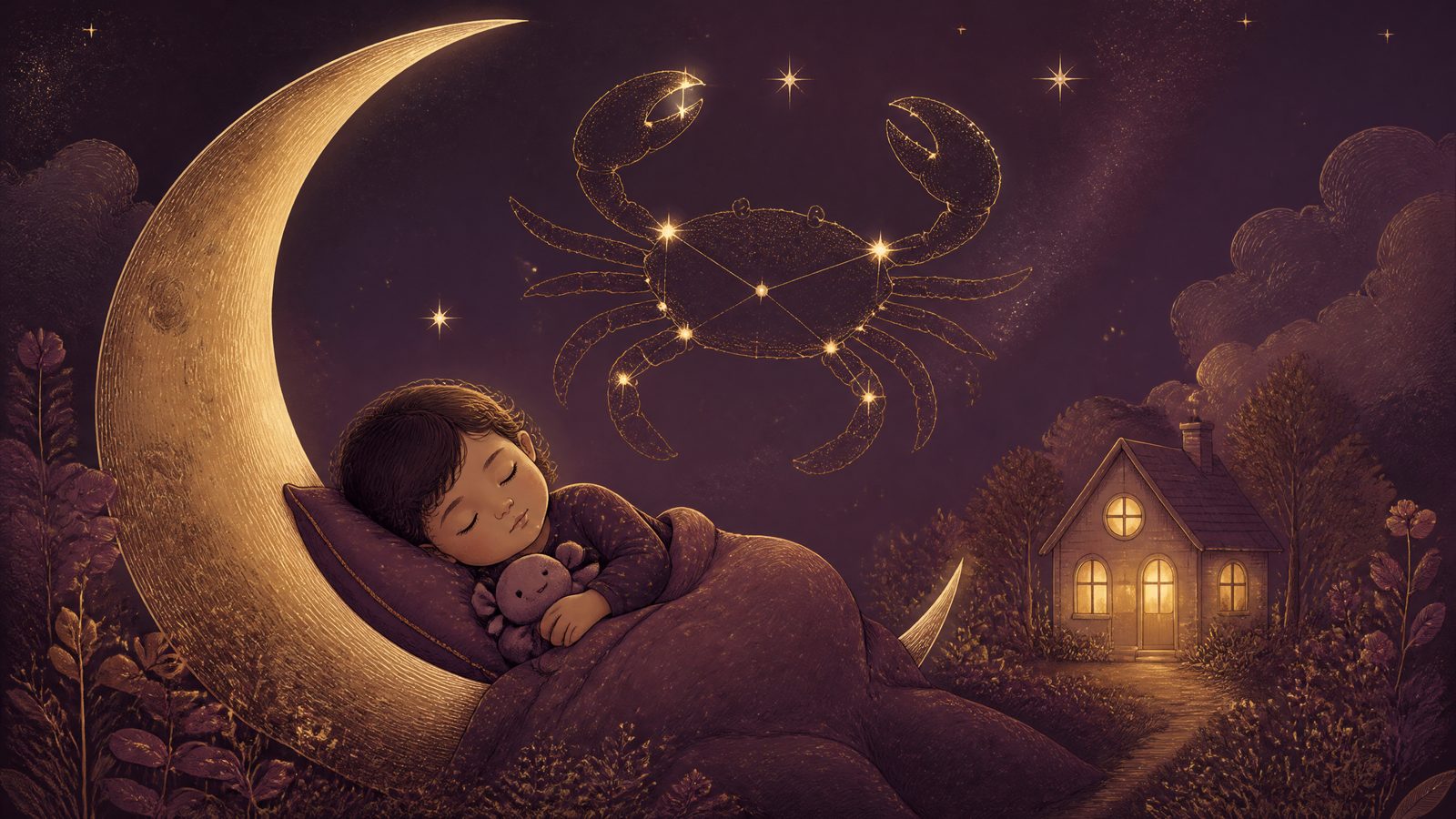
Cancer is the sign of the crab, and the crab explains a great deal. Soft inside, hard shell outside, always carrying home on its back.
- Feelings come first. Most Cancer kids take in the mood of a room before they take in a single word spoken in it.
- Home is the base. Familiar routines, familiar cups, familiar people. Change usually costs them more than it looks like from the outside.
- They remember how things felt. A sharp tone at breakfast can still be sitting in them at bedtime.
- They protect what they love. That includes their feelings, which they tend to guard with a retreat, a sulk or a sudden wall of tears.
What is underneath the storm
A few scenes show up again and again in Cancer households.
The transition meltdown. Leaving the park, switching off the show, changing plans. For a Cancer child the ending is a loss, even when the next thing is fun. The tears are often about the leaving, not the destination.
The "you hurt my feelings" explosion. You said "hurry up" in a tight voice and your child heard rejection. From the outside it looks like overreaction. From the inside the floor moved.
The tired-and-tender crash. Late afternoon, low fuel, one more small demand. A Cancer child who has been holding it together all day often lets go at the one place that feels safe enough: with you.
In all three, the lever you hold is the same. Before anything else, you can make the room feel safe again. That is something you control, tonight, without needing the child to cooperate first.
Try this the next time it crests: lower yourself to the floor beside them, not over them. Drop your voice below theirs. Say one sentence, "That felt like a lot. I'm right here." Then be quiet and stay. You are not agreeing that a blue cup is a catastrophe. You are showing that the shelter is still standing. Most Cancer kids start to soften when they feel your steadiness, and you can do this in under a minute.
The Moon layer: what actually settles a Cancer child
Cancer is ruled by the Moon, which makes the emotional layer of this chart especially loud. What soothes a Cancer child is warmth without a lecture attached: a lap, a blanket, a hand on the back, the soft predictable rhythm of your voice. Once the worst has passed, they usually need proof that the feelings did not cost them your affection. A snack, a familiar song, sitting close while nothing is demanded.
Your child's own Moon sign, the one in their actual chart, changes the details. A Cancer Sun with a Gemini Moon may want to talk it through lightly and move on. One with a Capricorn Moon often needs quiet and a little distance before they allow a hug. One with a Pisces Moon may dissolve into you and need to be held longer than seems reasonable. Offering the wrong kind of comfort can reopen a closing storm. This is where a general "Cancer" stops being enough and your particular child starts.
The Mercury layer: words that reach a sensitive shell
Mercury shapes how words land, and a Cancer Sun's Mercury is in Gemini, Cancer or Leo, which means the style can differ a lot from child to child. Across all three, tone usually arrives before content. A clipped "Enough!" gets heard as "you are too much," and the shell closes.
Try the same limit with the softness turned up: "I won't let you throw that, and I'm staying here with you." The boundary is the same, and the child tends to hear that they are still welcome.
A Cancer Sun with a Gemini Mercury often does better with short, light, curious phrasing. With a Cancer Mercury, feeling-words matter most: "sad," "scared," "left out." With a Leo Mercury, dignity matters. They usually want to hear that you see how big this is for them. Afterward, when the heat has dropped, a Cancer child can often name what happened if you offer the words gently first: "Was it that we left before you were ready?"
Three moves while it is cresting
- Shrink the room. Dim the lights, turn off the noise, move to a smaller space if you can. Less input tends to help a child who is feeling everything.
- Stay close, say less. One sentence of naming, then presence. Questions and explanations can wait for when the crying slows.
- Repair after. Once things are calm, offer a small ritual: a hug, a snack, a quiet story. It teaches that the bond survives big feelings, which is the lesson a Cancer child is usually asking for.
If the tantrums are very frequent, last far longer than seems typical for their age, involve hurting themselves or others, or leave you worried, your pediatrician is the right next step. Temperament is a lens on ordinary storms, not a replacement for a professional's eyes.
What this guide can't tell you
Everything above describes Cancer Sun temperament in general. The child on your kitchen floor is more than a Sun sign. Their Moon decides whether the storm wants holding or room, and how long the aftershock runs. Their Mercury decides which exact words reach them and which bounce off the shell. A Cancer Sun with a Virgo Moon and a Leo Mercury is a different child to calm than a Cancer Sun with a Pisces Moon and a Gemini Mercury.
There is also one more chart in the room that this guide can't see: yours. Part of every meltdown is how your wiring meets theirs. Whether a Cancer tear reads to you as something to comfort or something to fix often traces back to your own Sun and Moon, and you rarely chose it.
What you can reach for is reading your child's real Sun, Moon and Mercury alongside your own. The full reading on SIGNED is a one-time $9.99 purchase, written when you buy it, and it turns "a Cancer child" into your child, in words you can use tonight. A calmer, more connected home with this tender, perceptive kid is within reach for a mom who has read this far.
Quick answers
Why does my Cancer child have such big tantrums?
Cancer children tend to feel the emotional temperature of a moment very deeply, so a small disruption can land as a loss of safety. The tantrum is usually the overflow, not defiance. Meeting it with closeness and a calm voice tends to help more than correction in the middle of the storm.
How do I calm a Cancer child during a tantrum?
Lower yourself to their level, soften your voice, and say one steady sentence such as "That felt like a lot, I'm right here." Then stay close and say little. Most Cancer kids settle faster to felt safety than to explanations. Talk through what happened later, once the crying has slowed.
Why does my Cancer child cry when I raise my voice?
Many Cancer kids hear tone before words, so a raised or clipped voice can feel like rejection even when the rule behind it is reasonable. Holding the same limit in a lower, warmer voice usually lands better. If the crying seems far out of proportion, your pediatrician is the right next step.
Is my Cancer child being manipulative with the crying?
Usually not. For most Cancer children the feelings genuinely arrive at that size, and tears are their first language for needing shelter. Treating it as manipulation tends to push them further into the shell. A kind boundary plus real comfort is typically the combination that helps over time.
What should I do after a Cancer child's tantrum ends?
Repair the connection first. Offer a hug, a snack or a quiet story, and keep lectures out of it. Later, gently name what you saw: "I think leaving the park felt hard." It shows a Cancer child that big feelings do not cost them your love, so the next storm tends to feel smaller.