Cancer Moon Child: How to Help Them Feel Safe
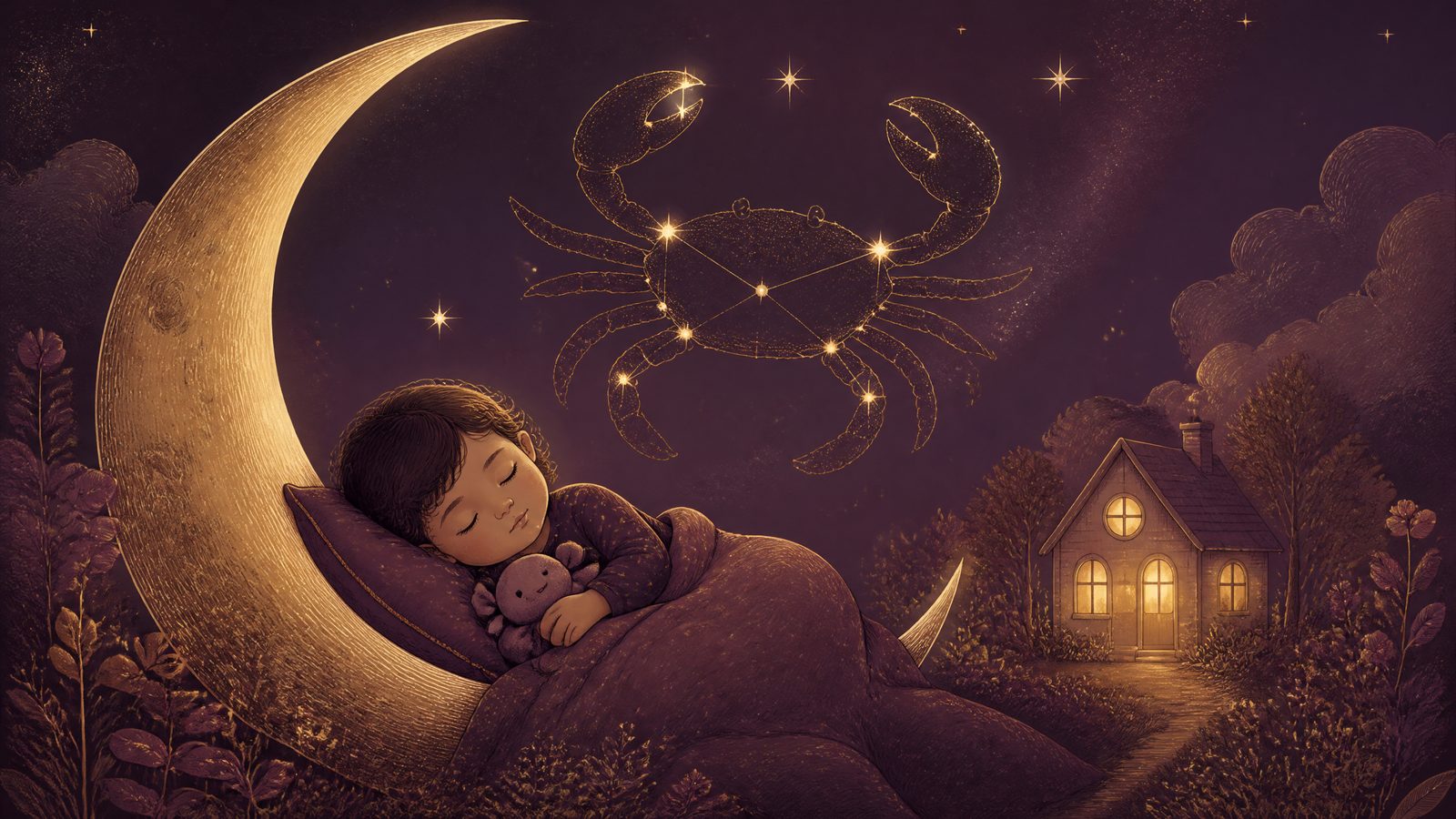
New to Cancer? Start with Parenting a Cancer Child: A Guide to Your Deeply Feeling One.
It's the third small thing tonight. The wrong cup, maybe, or a goodbye that came ten minutes too fast — and now your child is crying in a way that seems far bigger than any cup could explain. You've checked; nothing is actually wrong. And still the tears keep coming, like something that has been rising quietly all day finally found the crack to spill through.
If that scene is familiar, breathe with me for a second. You are not raising a dramatic child, and you did not do something to set this off. What you're watching is a Cancer Moon doing exactly what a Cancer Moon does — feeling everything, all the way to the bottom, and then looking for somewhere safe to set it down.
A Cancer Moon child isn't overflowing with too much emotion — they're carrying a full tide with no reliable shore to bring it in to. That shore is something you get to build. It's the whole reason this feels so hard right now, and the whole reason it can start to feel gentler.
Here's the part the meltdowns never show you. The Moon in a birth chart doesn't describe how a child behaves out in the world — that lives in other layers. The Moon is where they feel: what settles them, what rattles them, what has to be in place before they can rest. When the Moon sits in Cancer, that emotional dial is turned all the way toward safety. This child reads the temperature of a room the way other kids read a clock. They take in the mood at the dinner table, the tightness in your shoulders, the thing you decided not to say — and they keep it, sometimes for days, because that is what water does. It holds everything.
So the tears rarely match the trigger, because the trigger was never the real event. The broken cracker is only the place where a whole day of held feeling finally tips over. Once you can see that, you stop arguing with the cup. You start tending the thing underneath it: a felt safety so steady the tide finally has somewhere to go.
The safety a Cancer Moon is really asking for
For this child, feeling safe and being safe are two different things. You know the doors are locked and dinner is coming — they need to feel it in the body, and the way they feel it is through sameness. Predictability isn't a nice extra for a Cancer Moon; it's the container that holds the water. When the shape of the day is knowable — this comes after that, this is how we say goodbye, this is what bedtime sounds like — the big feelings have walls to press against instead of an open floor to flood across.
That's why routine does more for a Cancer Moon child than any pep talk ever could. A goodbye that runs the same every morning. A bedtime that unfolds in the same order every night. A heads-up before a transition, so the shift never lands as a shock. None of it is about rigid control; all of it quietly tells a deeply feeling child, in a language underneath words, the ground beneath you is not going to move tonight. Most of the flooding you're seeing tends to ease — not when the child toughens up, but when the days themselves become trustworthy.
And when a wave does break, because it will, what this child needs from you isn't a solution but a witness. A Cancer Moon tends to settle when the feeling is met, not managed. "That felt like way too much, and I'm right here" reaches somewhere a reasoned explanation simply can't. You're not being asked to stop the tide. You're being asked to be the shore it can break against safely — and you already hold what that takes, because it's presence, not perfection.
One honest note before we go further: big, easily-triggered emotion is temperament, not a diagnosis, and most of it eases as the container grows sturdier. But you know your own child better than any framework does. If the overwhelm keeps escalating, or something in it genuinely worries you, your pediatrician is the right next step — trusting that instinct is part of the job, never a failure at it.
Reaching them through the feeling, not around it
Talking to a Cancer Moon child asks for a different order of operations than you'd expect. When the tide is high, words don't get in — the feeling is using every channel at once. The urge to explain, to reason, to land the perfect sentence usually bounces right off, because you're handing logic to a child who is, in that moment, entirely underwater. Let the water drop first. Sit close, go quiet, let your steadiness carry the message. Co-regulation comes before conversation, every single time, with this one.
Then, once the storm has passed, pay attention to how your particular child lets things out — because that part is their Mercury, a layer all its own, separate from the Cancer Moon and different from child to child. Some need to talk it through in a rush. Some go sideways, telling you the real thing while you're driving or drawing, never head-on. Some have to route it through a story about a stuffed animal before it can be said aloud. A Cancer Moon child usually confides late and softly, often at bedtime, long after you assumed the moment had passed. Stay reachable in those hush hours. That tends to be when the shell opens on its own.
And keep your own voice lower than feels necessary. To a child this porous, an ordinary sharp tone can register as a full storm warning. The words most likely to reach them are the warm, unhurried ones — spoken beside them, not down at them.
Where this guide stops and your child begins
Everything here is true of a Cancer Moon in general — and your child is not a general. This maps the emotional layer, the Moon, but the way those feelings get spoken lives in their Mercury, and the way they meet the wider world lives in their Sun and beyond. A Cancer Moon paired with a quick, airy Mercury talks the storm right out; paired with a more guarded one, the same feelings go underground and need a slower door. The tides move differently depending on the whole sky they're moving under.
The piece no single-layer guide can hand you is this: half of every hard evening is your wiring meeting theirs. If you move fast and stay-the-course past feelings while your child moves slow and deep into them, the mismatch itself becomes part of the storm — and neither of you can see why. Reading your child's real Moon and Mercury alongside your own chart is what turns "a Cancer Moon" into your child, and turns tonight's guesswork into words that actually fit your home. A calmer, safer house with this tender, perceptive kid isn't wishful thinking for a mom who's read this far. It's the ordinary result of finally understanding what they've been asking you for all along.
Quick answers
What are a Cancer Moon child's emotional needs?
Above all, felt safety and sameness. A Cancer Moon child needs to sense — in the body, not only be told — that the ground is steady: predictable routines, unchanged goodbyes, a home base that reliably holds. Meet the feeling rather than fixing it, and those big tides tend to find somewhere safe to settle.
Why does my Cancer Moon child have such big feelings?
Because the Moon governs the inner emotional world, and in Cancer that dial is turned toward maximum sensitivity. Your child absorbs moods, tension, and unspoken things the way a sponge takes water, then holds them. The feelings aren't too big — they're deep, and they need a safe shore to come in to.
How do I help a Cancer Moon child feel safe?
Build predictability they can lean on. Keep goodbyes, mealtimes, and bedtime steady and same-shaped; warn them before transitions so change never ambushes them. When a wave hits, sit close and name the feeling rather than reasoning it away. Felt safety is presence plus routine — both are within your reach tonight.
Why does my Cancer Moon child fall apart over small things?
Usually the small thing isn't the real event — it's the last drop. A Cancer Moon child carries a whole day of absorbed feeling quietly, and the broken cracker is simply where the full cup finally spills. Don't argue the size of the trigger; tend the tide underneath it, and the overflow tends to ease.
How should I talk to a Cancer Moon child when they're upset?
When they're flooded, hold the words. A Cancer Moon child can't take in logic mid-wave, so co-regulate first: sit close, stay calm, let the tide drop. Talk once it's low — often sideways, during a drive or at bedtime, in a voice kept gentler than feels necessary. Connection opens the shell; pressure seals it.